
Construction Physical-Financial Schedule Template
Managing a civil construction project requires a delicate balance between what is being built on-site and the capital being deployed. This physical-financial schedule template serves as a comprehensive command center for engineers, contractors, and project managers. It bridges the gap between the construction timeline and the cash flow, ensuring that every brick laid corresponds to the planned budget. The template is structured with dedicated sections for work breakdown structures (WBS), where you can list phases like foundation, masonry, and finishing. It includes automated formulas that calculate percentage completion and financial disbursement over time, providing a clear view of your project's health through dynamic charts and summary tables.
The utility of this tool lies in its ability to prevent the common budget creep found in construction. By visualizing the planned versus actual progress through integrated charts, you can identify delays or overspending before they become critical issues. It is particularly useful for residential renovations, commercial builds, or infrastructure projects where stakeholders need regular updates on both physical milestones and financial status. Instead of juggling multiple spreadsheets, this template consolidates your Gantt-style timeline with a detailed cost breakdown, making it easier to manage contractor payments, material procurement, and labor costs. The inclusion of an S-curve visualization helps in understanding the pace of investment relative to the work performed, which is essential for maintaining liquidity throughout the build.
This template helps you track specific metrics such as the percentage of physical execution per month, the corresponding financial value of that work, and the cumulative totals for the entire project. By having this data in one place, you can provide transparent reports to clients or investors, showing exactly where the money is going and how much of the building is actually complete. It solves the problem of hidden costs and invisible delays by forcing a structured look at every phase of the construction lifecycle.
How to use this template:
- Define your project phases and specific tasks in the main schedule sheet, assigning start and end dates to establish your timeline and duration.
- Input the estimated costs or budget for each task, distributing the values across the months or weeks according to the planned execution.
- Regularly update the actual percentage of completion for each task as work is finished on-site to see the financial impact.
- Review the automated dashboard and S-curve charts to compare your planned progress against actual performance and adjust your strategy.
Expected benefits: This template significantly reduces the time required for financial reporting and project tracking, providing a professional framework that minimizes calculation errors and improves stakeholder communication.
Similar Templates Recommendation
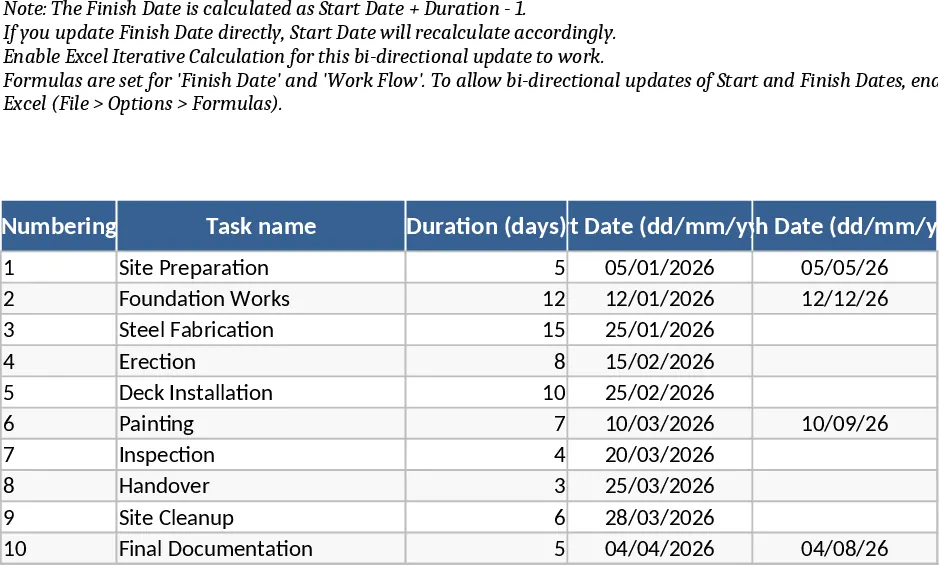
Steel Footbridge Construction Schedule Template
Plan and track your steel footbridge construction with this dynamic schedule featuring automated date calculations and a visual timeline.
Budget Forecast vs Actual Variance Tracker Template
Track your financial health by comparing planned budgets against actual spending to identify and manage cost deviations in real-time.
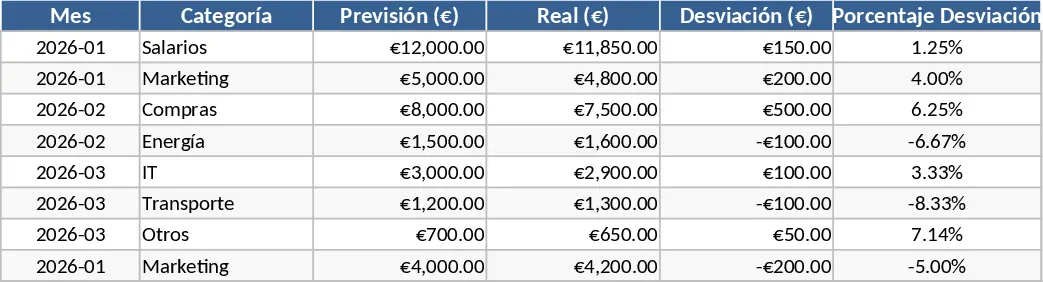
Budget Forecast vs. Actual Expenses Template
Monitor financial health by comparing planned budget allocations against actual expenses to identify variances and optimize your spending.