Key takeaways:
- Manually counting in Excel requires memorizing a family of functions like
COUNT,COUNTA,COUNTIF, andCOUNTIFS, each with specific rules and syntax that are easy to mix up. - Excel AI tools like RowSpeak eliminate the need for complex formulas by allowing you to ask for counts in plain language, such as "how many tasks are marked as 'Complete' in the North region?".
- Using RowSpeak for counting tasks dramatically reduces time spent on data analysis, minimizes errors from incorrect formulas, and provides the flexibility to ask follow-up questions on the fly.
The Daily Grind of Counting in Excel
Imagine you're a project manager staring at a spreadsheet with hundreds of tasks. Your director just walked over and asked, "How many high-priority tasks are overdue? And how many tasks haven't been assigned an owner yet?"
For many Excel users, this simple request triggers a mental checklist of questions: "Should I use COUNTIF or COUNTIFS? What's the syntax for 'not blank' again? Do I need to count numbers or text? What if the dates are formatted weirdly?"
This scenario is all too common. Whether you're in sales, marketing, HR, or finance, a significant part of your job involves summarizing data. You need to count sales from a specific region, survey responses that match certain criteria, or inventory items below a certain stock level. While Excel is powerful, getting these simple counts can often feel like a tedious, error-prone chore.
The Traditional Excel Solution: A Family of COUNT Functions
To solve these problems manually, Excel provides a "family" of counting functions. Each is designed for a slightly different purpose, and mastering them is a rite of passage for any serious Excel user.
Here’s a quick rundown of the traditional toolkit:
=COUNT(range): The most basic, but also the most limited. It only counts cells that contain numeric values. It ignores text, errors, and blank cells.=COUNTA(range): Counts all cells that are not empty. This includes numbers, text, dates, and even cells that contain formulas returning an empty string ("") or just a space, which can often lead to incorrect results.=COUNTBLANK(range): The opposite ofCOUNTA, this function counts all cells that are completely empty.=COUNTIF(range, criteria): The real workhorse. This lets you count cells that meet a single condition. For example, counting all tasks marked "Complete".=COUNTIF(C2:C100, "Complete")=COUNTIFS(criteria_range1, criteria1, [criteria_range2, criteria2]…): The advanced version. It counts cells that meet multiple conditions across different columns. This is what you'd use to find those "high-priority, overdue tasks."=COUNTIFS(B2:B100, "High", D2:D100, "<"&TODAY())
The Limitations of the Manual Approach
While these functions get the job done, they come with significant drawbacks:
- High Cognitive Load: You have to remember which function to use and its exact syntax. Did
criteria_rangeorcriteriacome first? Do I need quotation marks around">100"? It's a constant mental juggle. - Prone to Errors: A single misplaced comma or a typo in a criterion can break your formula or, worse, give you a silently incorrect answer. The infamous issue with
COUNTAincluding cells with hidden spaces is a perfect example of how easily things can go wrong. - Rigid and Inflexible: Your
COUNTIFSformula is built for one specific question. When your manager asks a follow-up—"Okay, now can you break that down by team member?"—you can't just "tweak" the formula. You have to start over, building a new, more complex one or creating a pivot table from scratch. - Difficult to Maintain: When you share your workbook, a colleague might not understand your complex nested formulas. If data is added, you have to manually update your ranges, risking breaking the logic.
This entire process turns a simple business question into a technical formula-writing exercise, pulling you away from the actual analysis.
The Modern Solution: Using an Excel AI Agent (like RowSpeak)
Instead of forcing you to learn a programming-like syntax, what if you could just ask your spreadsheet the question directly? That's the promise of Excel AI agents like RowSpeak. You upload your file and use natural language to get the answers you need, instantly.

Let's revisit the project manager's problem. Here’s how you’d solve it in RowSpeak.
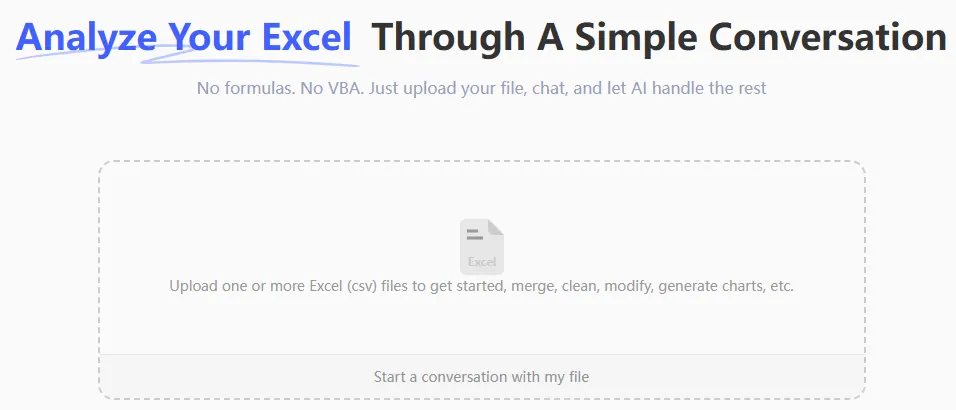
Step 1: Upload Your Data
First, you simply drag and drop your Excel or CSV file into RowSpeak. The AI will read your data and show you a preview, understanding the headers and data types automatically.
Step 2: Ask Your Counting Questions in Plain Language
Now, instead of writing formulas, you just type your questions into the chat interface. There's no special syntax to learn.
Here are some examples of how you can replace the entire COUNT family of functions:
To replace
COUNT:In the 'Hours Logged' column, how many entries are numbers?
To replace
COUNTA:How many tasks have a project owner assigned?
To replace
COUNTBLANK:Count the number of rows where the 'Completion Date' is empty.
To replace
COUNTIF:How many projects are in the 'In Progress' status?
To replace
COUNTIFS:Count the number of tasks with 'High' priority that are assigned to the 'Alpha Team'.
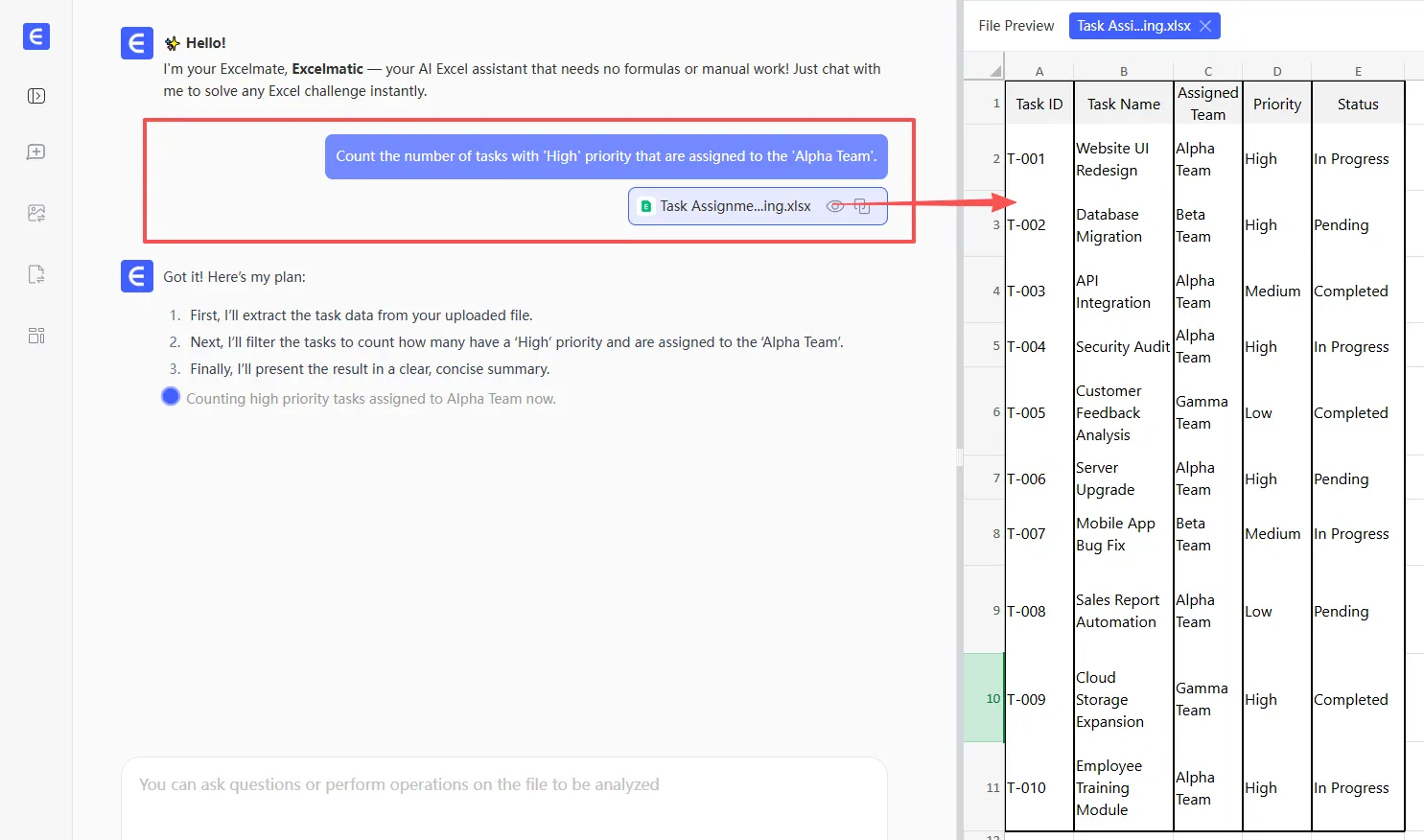
Step 3: Review and Iterate with Follow-up Questions
RowSpeak doesn't just give you a single number. It often provides a summary table and explains how it got the answer. The real magic happens next: you can continue the conversation to refine your analysis.
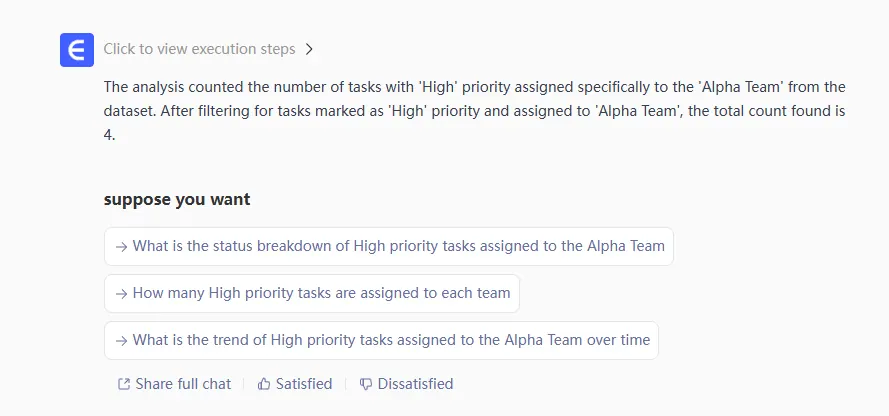
This conversational approach is impossible with traditional formulas.
Dialogue Example: A Real-World Scenario
Here’s what a typical conversation with RowSpeak might look like for a sales manager analyzing a sales log.
User: I've uploaded my Q2 sales data. First, how many sales were made in total?
RowSpeak: There are 1,482 sales transactions recorded in the file.
User: Great. Now, how many of those sales were from the "North" region?
RowSpeak: There were 312 sales from the "North" region.
User: Okay, of those North region sales, how many were for an amount greater than $1,000?
RowSpeak: In the "North" region, 78 sales were for an amount greater than $1,000. Here is a table showing the breakdown. Would you like me to visualize this?
User: Yes, create a bar chart comparing the total sales count for each region.
RowSpeak: Done. I have generated a bar chart showing the sales volume by region. You can download the chart or the updated Excel file below.
This fluid, iterative analysis takes seconds in RowSpeak but would have required multiple COUNTIFS formulas, a Pivot Table, and several formatting steps in traditional Excel.
Traditional Formulas vs. RowSpeak: A Quick Comparison
| Feature | Traditional Excel (Formulas) | RowSpeak (AI Agent) |
|---|---|---|
| Time to Answer | Minutes to hours, depending on complexity. | Seconds to minutes. |
| Learning Curve | High. Requires memorizing multiple functions and syntax. | Low. Requires only knowing your business question. |
| Flexibility | Low. New questions require new formulas. | High. Ask follow-up questions to refine results instantly. |
| Error Rate | High. Prone to syntax errors and logical mistakes. | Low. The AI handles the logic, ensuring consistency. |
| Collaboration | Difficult. Formulas can be hard for others to decipher. | Easy. The conversation history is a clear audit trail. |
FAQ
1. Do I need to know any Excel formulas like COUNTIF to use RowSpeak? No, not at all. The entire purpose of RowSpeak is to replace the need for writing formulas. You only need to be able to describe the result you want in plain language.
2. Is my data secure when I upload it to RowSpeak? RowSpeak is built with data security as a top priority. All data is encrypted in transit and at rest. For specific details on enterprise-level security and privacy policies, it's always best to consult the official website. Your original file is never modified.
3. What if my data is messy, with extra spaces or inconsistent formatting? RowSpeak's AI is designed to be robust against common data quality issues. You can also give it instructions to clean the data first, for example: "First, trim all whitespace from the 'Status' column, and then count how many are 'complete'."
4. Can RowSpeak count based on date ranges like "last quarter" or "this year"? Yes, absolutely. The AI understands relative date and time queries. You can ask things like "Count all sales that happened in the last 30 days" or "How many projects were completed in Q1 2024?" without needing to manually calculate the date ranges.
5. Is RowSpeak just for counting, or can it do more? Counting is just the beginning. You can ask RowSpeak to perform calculations (SUM, AVERAGE), create complex Pivot Tables, generate charts and graphs, merge datasets, clean data, write formulas for you, and even generate full reports.
Take Action: Revolutionize Your Excel Workflow with RowSpeak
Stop letting tedious formulas slow you down. Every minute you spend debugging a COUNTIFS formula is a minute you're not spending on strategic analysis. The cost of manual work isn't just time—it's the risk of errors, the lack of flexibility, and the frustration of a clunky workflow.
By embracing an Excel AI agent, you can transform your relationship with data. You can finally ask the questions you want, get immediate answers, and spend your valuable time on what truly matters: making data-driven decisions.
Ready to see for yourself? Try RowSpeak for free today and upload one of your own spreadsheets. Start with a simple counting question from this article and see how quickly you can get from data to insight.